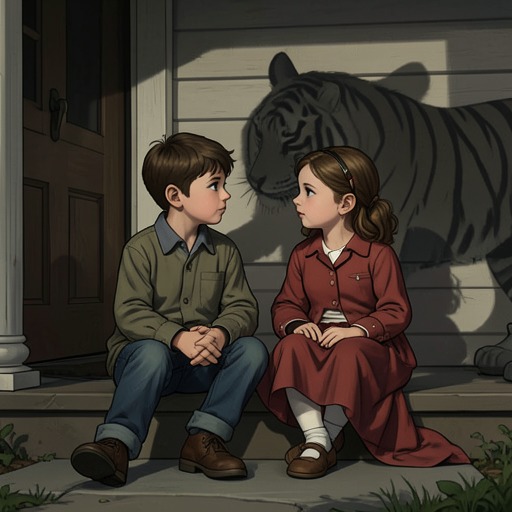
Rob and Sistine release the tiger, which Rob’s father shoots
The Tiger RisingThe release of the tiger by Rob and Sistine ends in the tiger’s death at the hands of Rob’s father, transforming an act meant to restore freedom into the crisis that breaks open Rob’s suppressed grief. The tiger’s escape is at first a shared triumph, but the gunshot from the direction of the motel changes its meaning: Rob returns to find the animal dead, confronts his father, and finally gives voice to the loss he had kept shut away.
Causes and Background
Rob and Sistine set out to free the tiger. Sistine insists that what matters is the animal and urges them to go, dismissing the possibility that her father might be coming to get her. Their purpose is clear, but the release itself is not guaranteed to go as they imagine: as the cage opens, Rob worries that the tiger may attack them, while Sistine believes it will leave them alone out of gratitude.
The first key enters the first lock with surprising ease, making Rob dizzy with amazement at how simple it seems to release the tiger. He opens the next two locks, removes them one by one, and hands them to Sistine, who places them on the ground. The practical sequence gives way to a moment of decision when Rob flings the door wide and calls for the tiger to come out.
The Tiger Leaves the Cage
The open door does not immediately produce the escape they expect. The tiger continues pacing, seemingly unaware of the way out. Rob tells him to go, then grows furious when the animal stops and looks at them. Clinging to the cage, Rob shakes it and yells. His anger builds as he looks up at the clouded sky, and his attempts to make the tiger leave become an outburst against the apparent delay.
Sistine puts a hand on Rob’s arm and tells him to watch. The tiger steps out with grace and delicacy, sniffs the air, takes a few small steps, and pauses. When Sistine claps, he looks back at them, then runs. From Rob’s perspective, his speed makes him seem to fly; his moving muscles are compared to a river, while the cage that had contained him now seems almost impossible to believe.
The tiger leaps through the grass, growing farther away from Rob and Sistine. Rob sees him like the sun rising and setting again and again, and feels his own heart rise and fall in time with the animal’s departure. Sistine says that freeing him was the right thing to do, and Rob nods. But his memory of Cricket flashes into his mind, complicating the relief of the apparent success with an earlier loss.
The Gunshot and the Confrontation
The release is abruptly overtaken by sounds from the motel. Rob hears his name called from that direction and recognizes his father’s voice. Then Willie May cries out, followed by the crack of a gun. Rob and Sistine stand stunned and silent. Willie May runs out from beneath the pine trees, sees the two children, and opens her arms to them. Rob walks toward her, wanting to tell her that he does not feel whole, but unable to find the energy or heart to say it.
Willie May leads them back. Rob sees the tiger lying on the ground and his father standing over it with the rifle. He feels an anger rise in him that he measures against the tiger’s size and power, and says that his father killed his tiger. His father answers that he had to. The moment overturns the children’s act of liberation: the tiger has left the cage, but has not escaped the violence waiting outside it.
Rob’s grief becomes action. He attacks his father, but recognizes that hitting him will not be enough. Instead, he opens the suitcase in which he has kept his unspoken words. The release of the tiger thus converges with a different release: Rob’s long-contained sorrow and anger finally find speech. He tells his father that he wishes he had been the one who died and that he needs his mother. The confrontation shifts the scene from the tiger’s death to the loss Rob has been unable to voice.
Consequences and Significance
The event moves through a stark reversal: the opened cage first promises freedom, and the tiger’s running seems to confirm that Rob and Sistine have done the right thing; then a gunshot and the sight of the dead animal make the outcome irreversible. The difference between the children’s hope and the result gives the release its force. Their action frees the tiger from confinement, but cannot protect him from Rob’s father’s gun.
For Rob, the tiger’s death is both an immediate bereavement and the trigger for a confrontation with his father. His words connect the animal he has just lost to the mother whose death he has kept locked away. Opening the suitcase marks a decisive breach in that silence: what Rob had held inside erupts into a direct expression of anger, hatred, and need. The event’s significance therefore lies not only in the tiger’s death, but in the painful emotional truth that follows it—Rob finally tells his father that he needs his mother.